Why Dubai Is a Different Question Than "the UAE"
Abu Dhabi and Ras Al Khaimah get most of the UAE mining headlines because of large-scale industrial power deals. Dubai is a different animal. There is no announced utility-scale mining farm inside Dubai's own grid footprint, and the emirate's single utility, Dubai Electricity and Water Authority (DEWA), prices power on a slab structure that was built for homes and offices, not sustained 3-6 kW ASIC loads.
That means the real Dubai decision isn't just "what's my electricity rate" — it's whether you run hardware on a Dubai meter at all, or pay a third-party facility to host it on an industrial connection elsewhere in the UAE. Both are legitimate paths. This post walks through the DEWA numbers, the actual Dubai-area hosting/colocation market, and the DMCC free-zone rules that determine how you'd structure a mining business if you're doing this as more than a hobby.
DEWA Electricity Rates: What You'd Actually Pay
DEWA bills on a slab (tiered) structure, and the published slab table applies to residential and general commercial accounts alike:
| Consumption band | Rate |
|---|---|
| 0–2,000 kWh/month | 23 fils/kWh |
| 2,001–4,000 kWh/month | 28 fils/kWh |
| 4,001–6,000 kWh/month | 32 fils/kWh |
| 6,001+ kWh/month | 38 fils/kWh |
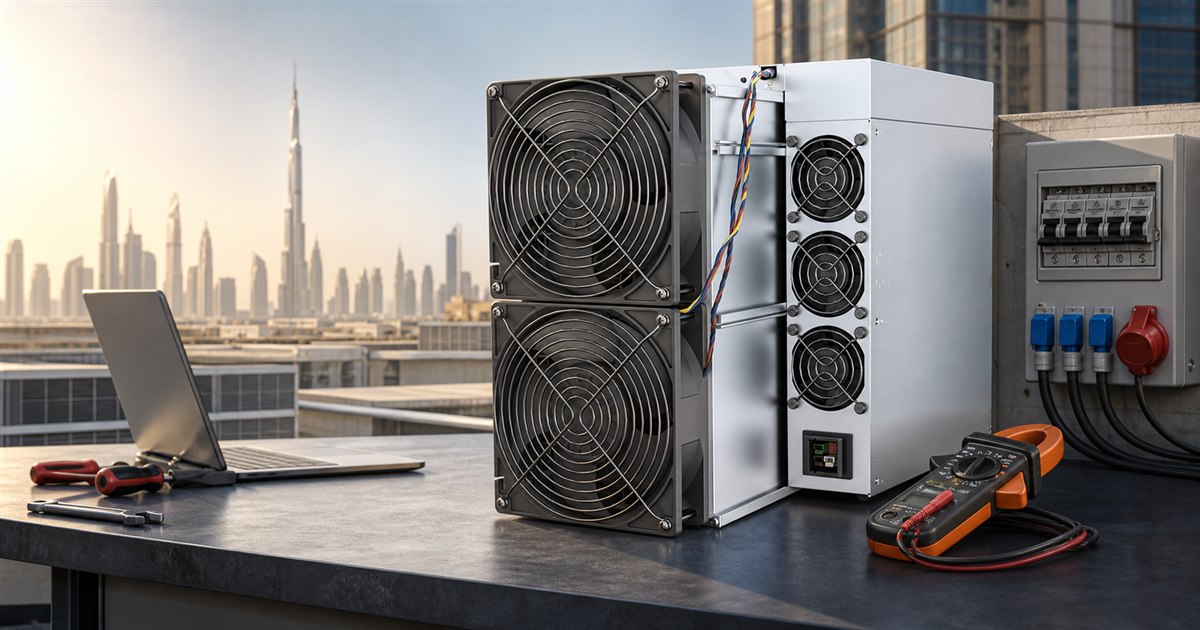
A single modern air-cooled ASIC like the Antminer S21+ (3,564W) run 24/7 draws roughly 2,570 kWh a month on its own — enough to land most of its consumption in the 28-32 fils band before you've plugged in a second unit. Run two or three units on a residential meter and you're solidly into the 38 fils top slab for the whole month, not just the marginal kWh.
On top of the slab rate, DEWA adds a fuel surcharge that resets monthly — it was quoted at 6.0 fils/kWh for July 2026 — plus a fixed monthly meter service charge and 5% VAT on the full bill. Separately, multiple UAE utility-billing sites report that DEWA's non-residential (commercial) accounts have paid a flat 38 fils/kWh regardless of volume since a January 2022 tariff update, while dedicated industrial accounts get a more favorable structure — roughly 23 fils/kWh up to 10,000 kWh before stepping up. These figures come from third-party DEWA billing guides rather than a live DEWA tariff card we could pull directly, so treat them as a starting point and confirm your exact rate class with DEWA or your building's facilities team before running real numbers — slab and surcharge figures do move.
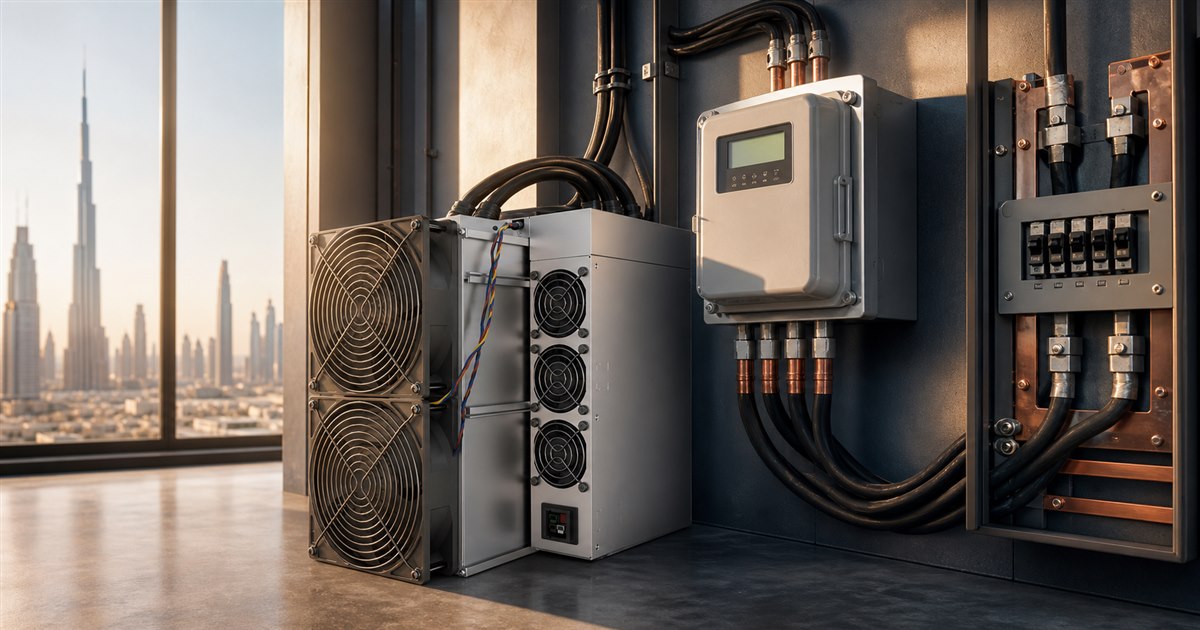
The practical takeaway: a residential DEWA connection is close to the worst-case rate for ASIC mining once you're running more than one or two units. An industrial account, where available, is meaningfully cheaper. That gap is the entire reason a third-party hosting facility on its own industrial connection can undercut self-hosting even after its management fee.
Hosting: Running Your Hardware on Someone Else's Meter
Dubai itself has hosting/colocation operators rather than DEWA-connected mining farms at grid scale, and pricing here is public in a way electricity tariffs aren't. MinersHub, headquartered in Dubai Investment Park 1, publishes an all-in colocation rate of $0.067/kWh for deployments up to 100 miners, covering power, transformer amortization, security, monitoring, and customs handling — with tiered discounts negotiated for 100+ and 500+ miner/1 MW+ deployments. They run three cooling tiers: standard air (no minimum unit count, $50/miner setup), closed-loop hydro (4-unit minimum, $600/slot plus $750/miner), and oil immersion (2-unit minimum, $600/slot plus $800/slot). The company reports 4.5 MW of available UAE capacity within a 50 MW operation spanning 21 facilities across the UAE and Oman, running since 2016.
CryptoMiners, based in Al Garhoud, Dubai, publishes separate rates for its two cooling options: $0.065/kWh for hydro cooling and $0.075/kWh for air cooling, and reports 97.83% measured facility availability across the twelve months to August 2026.
Both numbers sit well below any DEWA residential or flat-commercial slab, which is the point of hosting: you're buying access to an industrial-scale electricity contract and purpose-built cooling that would be impractical to replicate in a Dubai apartment, villa, or small office. The tradeoff is the management fee baked into the per-kWh rate and losing direct physical access to your own hardware.
Free Zones and Licensing: What DMCC Actually Covers
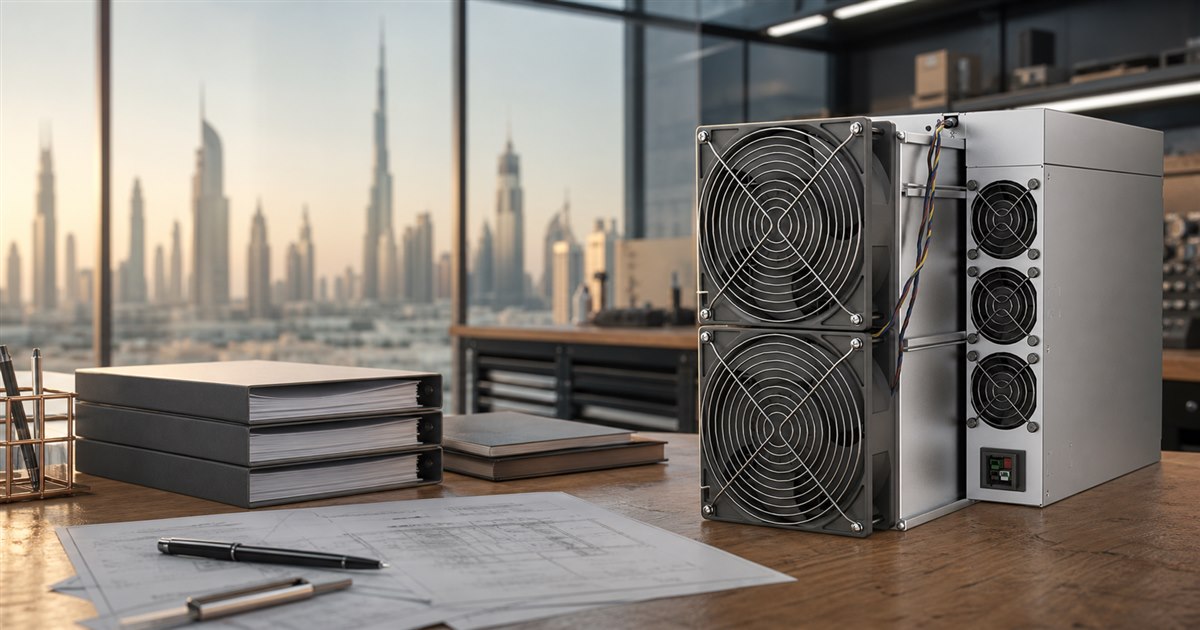
Dubai's free zones come up constantly in mining discussions because of DMCC's Crypto Centre, but the licensing picture is narrower than it sounds. Running ASICs for your own account — buying hardware and mining to your own wallet — is generally treated as an ordinary commercial or industrial activity in the UAE and does not by itself require a VARA (Virtual Assets Regulatory Authority) license. VARA authorization becomes relevant when you're offering crypto-related services to clients — custody, exchange, hosting-as-a-service sold to third parties — not when you're simply operating your own machines.
Free zones including DMCC offer license categories like "Distributed Ledger Technology Services" or general data-processing/IT-infrastructure categories that a mining operation can register under if you want the free-zone benefits (100% foreign ownership, no corporate tax on qualifying free-zone income, streamlined visas). DMCC's own dealing-license category for crypto businesses carries additional obligations — disclosing your energy-procurement mix, demonstrating participation in green-energy or carbon-offset schemes, and publishing an annual environmental impact statement — but that rulebook targets crypto dealing and trading activity specifically, not a straightforward hardware-hosting or self-mining setup.
If you're mining as an individual with a handful of machines at home or in a hosted rack, none of this free-zone machinery is a prerequisite. It becomes relevant once you're structuring a company, want the free-zone tax and ownership benefits, or plan to offer hosting/services to other people.
Efficiency Still Decides the Outcome
Whichever path you take — DEWA meter or hosted rack — the hardware's J/TH figure determines how much of your revenue the electricity bill eats. Here's a spread from our current in-stock catalog:
| Miner | Hashrate | Power | Efficiency | Price |
|---|---|---|---|---|
| Antminer S19j Pro+ | 122 TH/s | 3,355W | 27.5 J/TH | $450 |
| Whatsminer M60S | 186 TH/s | 3,422W | 18.4 J/TH | $2,250 |
| Antminer S21+ | 216 TH/s | 3,564W | 16.5 J/TH | $3,600 |
| Antminer S21 XP Hyd | 473 TH/s | 5,676W | 12.0 J/TH | $7,200 |
The hydro-cooled S21 XP Hyd is the most relevant entry for anyone hosting in Dubai's heat or placing hardware in a colocation facility's hydro/immersion tier — the lower J/TH directly reduces the per-TH electricity cost that both DEWA slab rates and hosting per-kWh rates get multiplied against, and hydro cooling sidesteps the thermal derating that air-cooled units face against a high ambient. For a budget entry point or a first unit to test a hosting relationship before committing more capital, the S19j Pro+ is the cheaper way in, though its 27.5 J/TH means it needs a meaningfully lower electricity rate to clear the same margin.
Because BTC price, network difficulty, and your actual electricity rate all move independently, any single ROI figure here would be a projection, not a fact — run your specific hardware and rate combination through our profitability calculator rather than trusting a static number that goes stale within weeks.
Getting Hardware to Dubai
We ship worldwide via DHL — a flat $150 shipping fee, waived entirely on orders over $5,000, which covers most multi-unit Dubai orders outright. Every unit carries the manufacturer's standard 6-12 month warranty depending on model, extendable to 18 months through our paid Premium Guarantee if you want coverage that outlasts the first year of a Dubai summer's thermal stress on air-cooled hardware.