Why Solar and Mining Actually Fit Together
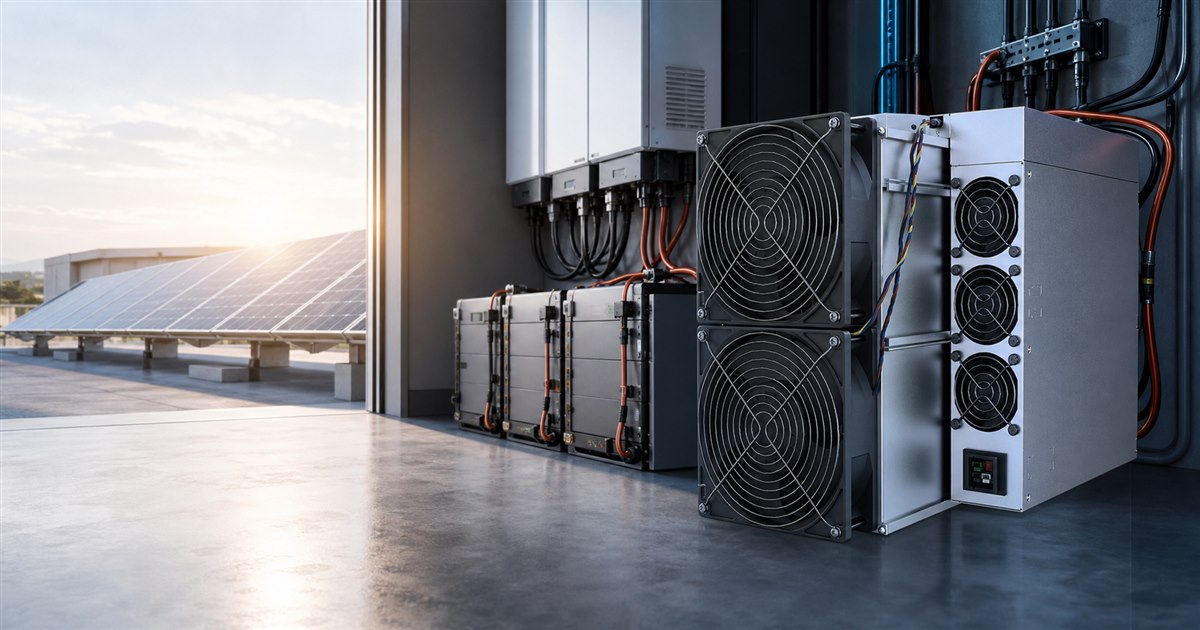
Electricity is the largest recurring cost in ASIC mining, full stop. Solar power doesn't just reduce that cost — for the hours panels are producing at capacity, it can push the marginal cost of mining close to zero. That's a fundamentally different economic position than any grid-tied setup can offer, hence the growing interest in solar-paired mining rigs even among buyers who'd never call themselves "green."
The catch is that miners run 24 hours a day and the sun doesn't. Every decision in this guide — which miner you buy, how much panel and battery capacity you install, whether you stay grid-tied — comes back to reconciling those two facts. Get the sizing wrong and you either pay for panels that sit idle at night or buy a miner your array can never fully feed.
What You Actually Need
| Component | Role |
|---|---|
| Solar panels | Generic 350–450W monocrystalline panels are the standard building block; exact brand and price depend on your installer and region |
| Inverter | Converts DC panel output to AC for the miner, sized to the miner's continuous power draw plus headroom |
| Battery storage | Enables operation through night hours or cloud cover, and smooths brief voltage dips |
| Charge controller | Manages power flow, protects batteries from overcharge |
| ASIC miner | Choose a draw and efficiency that match what your array can realistically support |
MinerHaolan doesn't sell solar equipment, so treat the panel/inverter/battery specs above as generic categories, not product recommendations. A local solar installer or electrician should size and quote the actual hardware for your site — what follows is the math you'd bring to that conversation, not a substitute for it.
Choosing a Miner for a Solar Setup
The single biggest lever in a solar mining build isn't the panels — it's the miner's power draw. A lower-wattage unit shrinks every downstream number: fewer panels, a smaller inverter, less battery capacity if you're going off-grid. Here's a spread of in-stock units from the live catalog, from the smallest draw to a flagship hydro unit, to show how differently they'd need to be sized:
| Miner | Hashrate | Power Draw | Efficiency | Price | Solar Fit |
|---|---|---|---|---|---|
| Bitaxe Gamma 602 | 1.3 TH/s | 15W | 11.5 J/TH | $89 | Runs off a single small panel; easiest possible off-grid build |
| Lucky Miner LV07 Pro | 3 TH/s | 50W | 16.7 J/TH | $199 | A single 300–400W panel can cover this with margin |
| Antminer S19j Pro | 104 TH/s | 3,068W | 29.5 J/TH | $360 | Needs a real array; higher J/TH means more panels per TH than newer models |
| Antminer S21+ | 216 TH/s | 3,564W | 16.5 J/TH | $3,600 | High-efficiency flagship; still a meaningful array and battery bank for full coverage |
| Antminer S21 Hyd | 335 TH/s | 5,360W | 16 J/TH | $5,400 | Largest continuous load here; hybrid grid+solar is the realistic path, not full off-grid |
The pattern holds across the whole catalog, not just these five: a lower J/TH figure means more hashrate per watt, which matters for your electricity bill either way, but it's the raw watt figure — not the efficiency rating — that actually drives how many panels and how much battery you need. A S21+ and an older S19j Pro can draw a similar amount of power; the S21+ just gets more hashrate out of that same draw. Neither gets easier to solar-power than a Bitaxe or a Lucky Miner pulling under 100W.
If your goal is a genuinely simple off-grid build — one or two panels, no serious battery bank, something you could run off a balcony or a shed — the small single-board miners in the table are the realistic starting point. If your goal is meaningful hashrate, you're sizing a real solar installation, not a hobby project, and the worked examples below show why.
Sizing Your System: A Worked Example
Assumptions stated up front: this example uses 5 peak sun hours per day, a reasonable planning figure for a sun-belt location like the U.S. Southwest in spring/fall, and assumes a modest 15% system loss for wiring, inverter conversion, and panel soiling. Peak sun hours vary substantially by latitude, season, and local weather — a site in northern Europe or a rainy climate could see half that in winter. Get a location-specific number from a solar installer or a tool like NREL's PVWatts before buying hardware; this is illustrative math, not a site assessment.
Take the Antminer S21 Hyd (5,360W draw) as an example of a high-draw flagship:
Now compare that to the Lucky Miner LV07 Pro at 50W:
Same sizing method, radically different outcome. Choosing a more efficient, lower-power miner — or accepting a mining schedule that follows daylight hours rather than demanding true 24/7 grid-independent operation — both meaningfully shrink the panel and battery capacity needed.
Battery and Inverter Sizing: Continuous vs. Surge
ASIC miners are a steadier load than people expect. Once running, a miner's switching power supply draws close to its rated wattage continuously — there's no large motor-start inrush the way there is with, say, an air conditioner compressor. That means the number that matters most for inverter sizing is the miner's continuous power rating, not a surge rating.
That said, give yourself headroom rather than sizing to the exact nameplate figure:
There's a second reason to over-provision battery buffering even in a hybrid system: miners don't like being power-cycled repeatedly. A hashboard that browns out, restarts, and re-syncs every time a cloud passes over isn't just losing hashrate during the outage — repeated power cycling is harder on PSUs and hashboards than steady operation, and repeated resyncs add overhead on top of the downtime itself. A modest battery buffer that rides through short voltage dips, even one sized well below full night-time coverage, protects the hardware in a way that pure panel-to-miner wiring doesn't.
Hybrid vs. Fully Off-Grid
Hybrid (grid + solar) is the more practical starting point for almost everyone: solar offsets electricity cost during daylight hours, grid power covers nights and low-sun days, and you avoid both the battery-capacity cost and the power-cycling risk of true 24/7 off-grid operation.
Fully off-grid removes the electricity bill entirely but requires meaningfully larger battery storage to cover night hours and cloudy stretches — the upfront capital cost is substantially higher, and it only really pencils out where grid connection itself is expensive, unreliable, or unavailable. It tends to make more sense for the small single-board miners in the table above than for a multi-kilowatt flagship.
Buying Hardware for a Solar Build
A few catalog and shipping facts worth knowing before you order:
The full range of in-stock Bitcoin miners, from sub-100W single-board units to multi-kilowatt hydro flagships, is browsable at /shop.