The Core Tradeoff: Simplicity vs. Performance
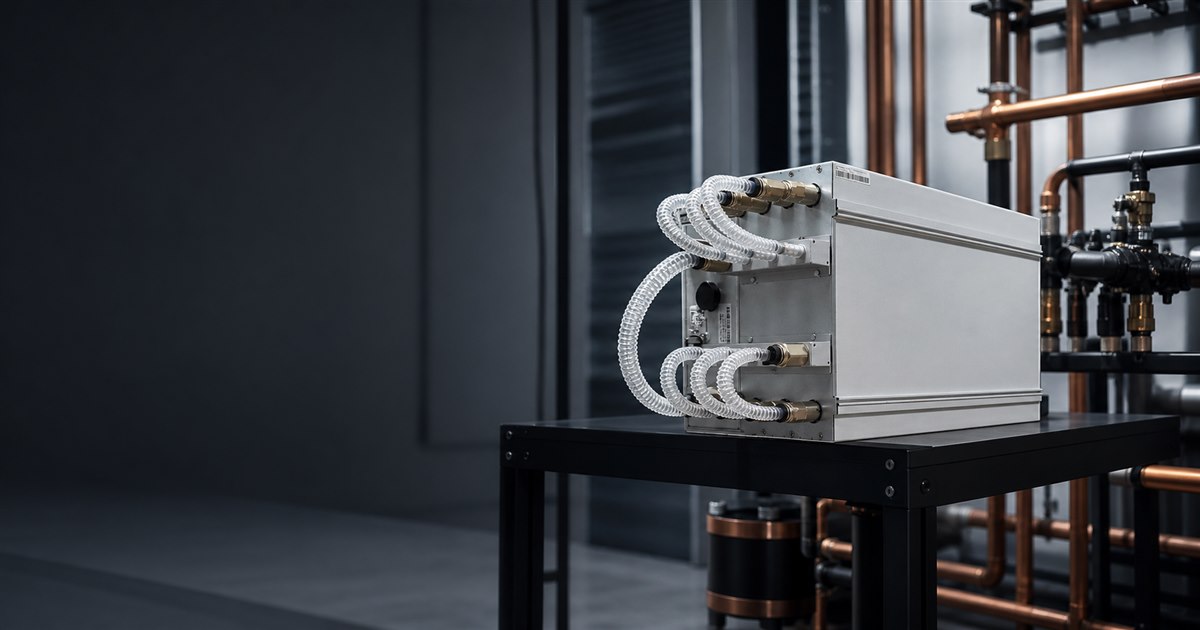
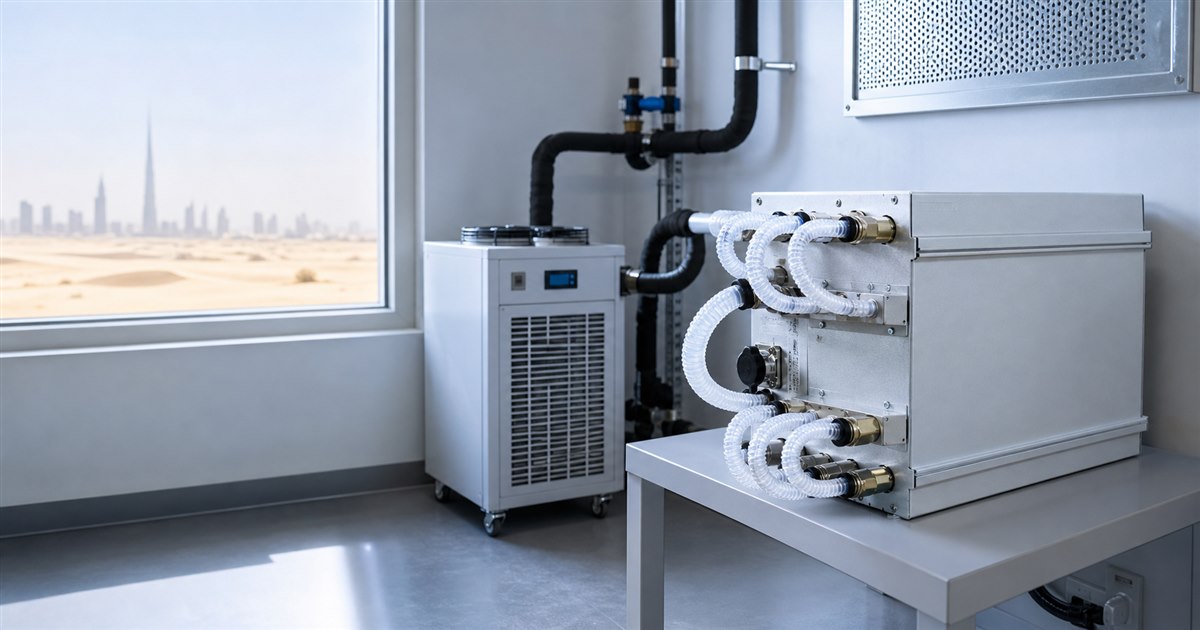
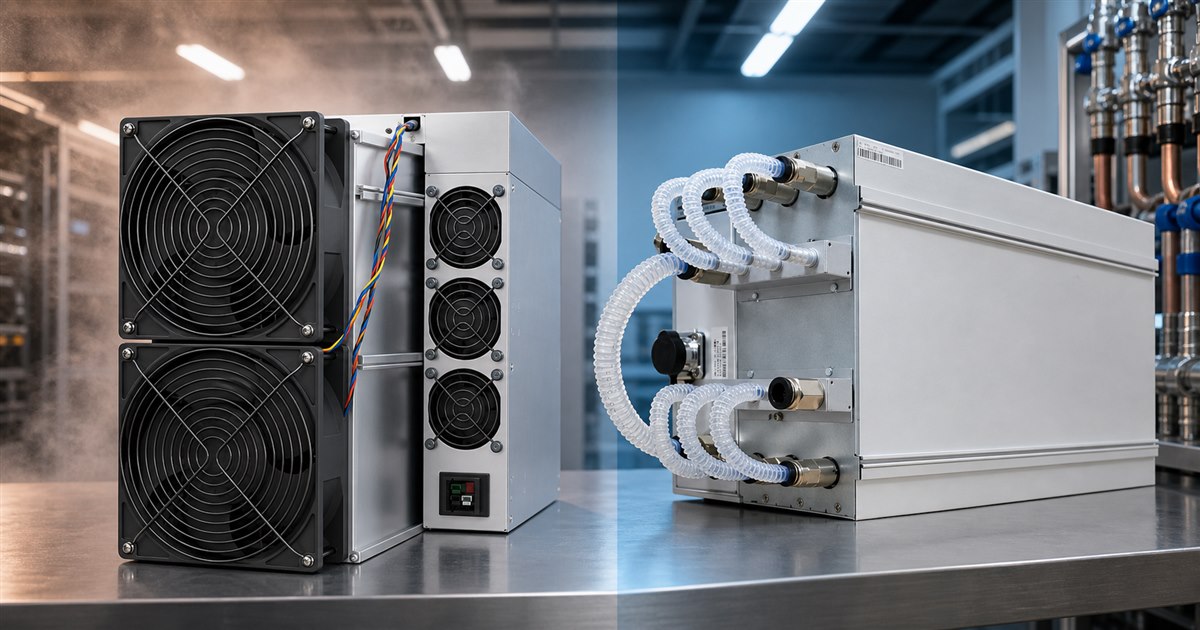
Every ASIC miner has to move heat out of the chip and into the room, or it throttles and dies early. There are three ways to do that. Air cooling uses fans and a heatsink. Hydro cooling runs coolant through cold plates bolted directly to the hashboards, then dumps that heat into a radiator. Immersion cooling skips air and plumbing entirely and submerges the whole board in a tank of dielectric fluid that doesn't conduct electricity.
All three work. The question is which one fits your electricity rate, your space, and your noise tolerance — and that's usually the first fork in the road when you're shopping the full catalog, before brand or price even come into it.
Air-Cooled Miners: What You're Actually Buying
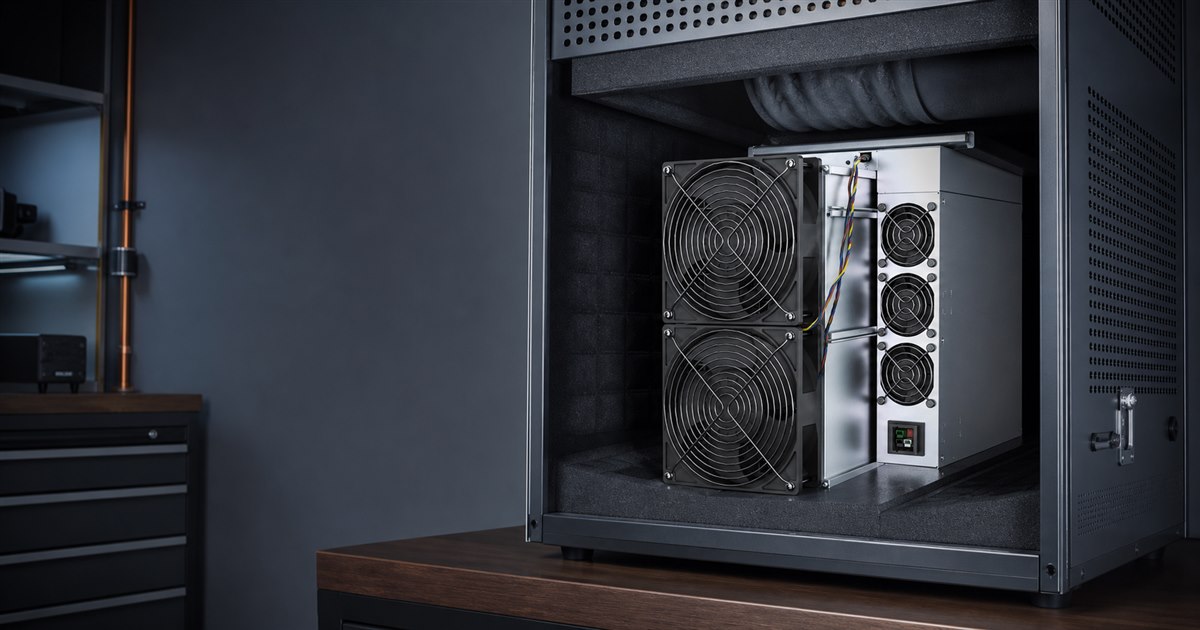
Air cooling is the default for a reason. There's no plumbing, no coolant to bleed, no pump to fail, no tank to fill. You unbox it, rack it, plug it in.
Current air-cooled inventory spans a wide range:
| Miner | Hashrate | Power | Efficiency | Price |
|---|---|---|---|---|
| Antminer S19j XP | 151 TH/s | 3,247W | 21.5 J/TH | $720 |
| Antminer S19k Pro | 120 TH/s | 2,760W | 23 J/TH | $900 |
| Antminer S21 | 200 TH/s | 3,500W | 17.5 J/TH | $3,150 |
| Antminer S21 XP | 270 TH/s | 3,645W | 13.5 J/TH | $5,850 |
These are reliable, well-documented, and the cheapest way into serious hashrate per dollar spent upfront.
Hydro-Cooled Miners: What You're Paying For
Hydro cooling isn't a gimmick — liquid has a much higher thermal transfer coefficient than air, and cold plates pull heat off the silicon faster and more evenly than a heatsink-and-fan setup. A few real examples from current inventory:
| Miner | Hashrate | Power | Efficiency | Price |
|---|---|---|---|---|
| Antminer S19 Hydro | 158 TH/s | 5,451W | 34.5 J/TH | $1,620 |
| Whatsminer M56S Hydro | 298 TH/s | 5,550W | 18.6 J/TH | $3,150 |
| Antminer S21 Hyd | 335 TH/s | 5,360W | 16 J/TH | $5,400 |
| Antminer S21 XP Hyd | 473 TH/s | 5,676W | 12.0 J/TH | $7,200 |
Why hydro usually wins on noise and, on the flagship tier, on efficiency
30-40 dB is roughly library-quiet, versus 70-80 dB for air — the difference between a miner that has to live in a dedicated shed and one that can sit in a garage or spare room unnoticed. On efficiency, the pattern holds cleanly at the S21 tier: air-cooled S21 runs 17.5 J/TH, the hydro S21 Hyd runs 16 J/TH, and both undercut older air-cooled generations. Cooler, more even chip temperatures let the same silicon run a tighter voltage/frequency curve without throttling.
What hydro costs you
Immersion Cooling: The Third Option
Immersion drops the entire hashboard into a tank filled with a non-conductive dielectric fluid — no fans, no cold plates, no separate coolant loop through the board itself. Heat moves straight from the chip into the fluid, which is then circulated through an external heat exchanger. It's the quietest option by a wide margin and, done right, the most even thermal distribution across every chip on the board.
Real examples currently in stock:
| Miner | Hashrate | Power | Efficiency | Price |
|---|---|---|---|---|
| Avalon A1246I Immersion | 100 TH/s | 3,200W | 32.0 J/TH | $540 |
| Avalon A1466I Immersion | 160 TH/s | 2,900W | 18.1 J/TH | $1,440 |
| Whatsminer M60S Immersion | 212 TH/s | 3,906W | 18.4 J/TH | $2,700 |
| Antminer S21 Immersion | 400 TH/s | 5,200W | 13 J/TH | $6,300 |
Immersion is the most capital- and space-intensive of the three: you need a tank sized for the unit, several gallons to tens of gallons of dielectric fluid (which isn't cheap and needs periodic filtering), an external pump and heat exchanger, and a way to service a board without spilling fluid everywhere. It's overkill for a single home miner in most cases — the tank and fluid cost alone can exceed the price difference between an air and hydro unit at the same hashrate. It earns its keep at farm scale, where one shared fluid loop and heat exchanger can serve racks of boards at once, and in hot, humid, or dusty environments where even a hydro radiator would struggle with ambient heat rejection.
Same Chip, Different Cooling: What Actually Changes
Comparing the same base chip across cooling methods is the cleanest way to see what you're paying for. Canaan's Avalon A1246/A1466 line ships in both air and immersion versions:
| Model | Cooling | Hashrate | Power | Efficiency | Price |
|---|---|---|---|---|---|
| Avalon A1246 | Air | 90 TH/s | 3,420W | 38.0 J/TH | $360 |
| Avalon A1246I Immersion | Immersion | 100 TH/s | 3,200W | 32.0 J/TH | $540 |
| Avalon A1466 | Air | 150 TH/s | 3,300W | 22 J/TH | $1,170 |
| Avalon A1466I Immersion | Immersion | 160 TH/s | 2,900W | 18.1 J/TH | $1,440 |
Both pairs show the immersion version pulling more hashrate at lower power and better J/TH than its air-cooled sibling — a real efficiency gain from the same silicon family, not just marketing. The same trend holds for Bitmain's S21 line: air-cooled S21 runs 17.5 J/TH, and the S21 Immersion version runs 13 J/TH at nearly double the hashrate.
Worth being direct about: this isn't automatic across every SKU. Hydro and immersion versions sometimes pack more hashboards into the same chassis rather than simply re-cooling an identical board — the Antminer S19 Hydro runs 34.5 J/TH, statistically flat against its air-cooled S19 sibling at 34.2 J/TH, because it's a denser multi-board unit built for raw output, not a pure efficiency play. Check the actual spec sheet rather than assuming liquid cooling always wins on J/TH — on newer flagship silicon it consistently does; on some higher-density hydro SKUs it doesn't.
Side-by-Side Comparison
| Factor | Air-Cooled | Hydro-Cooled | Immersion-Cooled |
|---|---|---|---|
| Unit cost | Lowest | Higher | Highest (incl. tank + fluid) |
| Noise | 70-80 dB | 30-40 dB | Near-silent (no fans) |
| Efficiency (J/TH) | Good | Better on newer flagship silicon | Best on newer flagship silicon |
| Setup complexity | Plug-and-play | Requires plumbing | Requires tank, fluid, heat exchanger |
| Maintenance | Dust filter, compressed air | Coolant top-off, fitting checks | Fluid filtering, tank servicing |
| Best for | Industrial/warehouse space | Home, office, noise-sensitive sites | Farm scale, extreme heat/dust |
| Climate tolerance | Struggles in heat/humidity/dust | Handles heat well | Handles heat and dust best |
Decision Framework: Which Should You Buy?
| Your situation | Recommended cooling |
|---|---|
| Dedicated warehouse or industrial space, lowest cost per TH is the priority | Air-cooled |
| Mining in a garage, spare room, or office where noise matters | Hydro-cooled |
| Hot or humid climate, no space for a dedicated shed | Hydro-cooled or immersion |
| Single home unit, budget-conscious | Air-cooled (or hydro if noise is the dealbreaker) |
| Small farm (5-20+ units), electricity above roughly $0.06/kWh | Hydro-cooled |
| Farm scale in extreme heat, dust, or humidity, willing to invest in a shared fluid loop | Immersion |
| Maximum efficiency per watt, budget is secondary | Immersion (on flagship silicon) or top-tier hydro |
Shipping and Warranty Notes
All three cooling types ship worldwide via DHL — flat $150, or free on orders over $5,000. Most flagship hydro units (S21 Hyd at $5,400, S21 XP Hyd at $7,200) and immersion units (S21 Immersion at $6,300) clear that threshold on their own, while entry-level air, hydro, and immersion units generally won't unless bundled.
Every unit carries the manufacturer's standard 6-12 month warranty, extendable to 18 months through the paid Premium Guarantee. For hydro and immersion units, that extra coverage is worth weighing against air-cooled's simpler claim path — a pump, fitting, or tank failure is a different repair conversation than a fan swap.
The Bottom Line
Go air-cooled if you have dedicated industrial or warehouse space where noise and ambient heat aren't a constraint, and you want the lowest cost per terahash to start. Air remains the most capital-efficient path into serious hashrate, and our Antminer S21 XP is a solid example at $5,850 for 270 TH/s.
Go hydro-cooled if you're mining anywhere near living or working space, in a hot climate, or you're running at a scale where the efficiency gap on your electricity bill outweighs the higher unit price over 12-18 months. For most home and small-farm buyers today, a unit like the Antminer S21 Hyd hits the sweet spot — quiet enough to live with, efficient enough that the price premium pays for itself.
Go immersion if you're operating at farm scale, in a genuinely hostile climate for cooling (extreme heat, humidity, or dust), or chasing the absolute best J/TH the market currently offers and can absorb the tank and fluid investment across enough units to make it worthwhile. For a single machine, run the numbers with our profitability calculator before committing — the tank and fluid cost rarely pencils out for one unit alone. To weigh specific models side by side across all three cooling types, our comparison tool pulls live specs from the same catalog used here.